Winning the Australian Open, Roland-Garros, Wimbledon, and the US Open in the same season: we are talking about the calendar Grand Slam, a feat so rare that the list of players who have accomplished it fits on one hand. Before reviewing these names, a clarification often overlooked deserves to be stated right away: the four tournaments are not played on the same surfaces, and this technical constraint changes everything.
Three surfaces, four tournaments: the concrete difficulty of the calendar Grand Slam
The current circuit requires winning on hard (Australian Open, US Open), clay (Roland-Garros), and grass (Wimbledon). Each surface alters the bounce height, ball speed, and type of game required. A clay specialist may dominate at Roland-Garros without ever breaking through on grass, and vice versa.
This configuration of three surfaces is relatively recent. When Rod Laver achieved his two calendar Grand Slams, the US Open was still played on grass. The achievement remained considerable, but the diversity of surfaces was less than it is today. Tennis governing bodies (ITF, ATP, WTA) now acknowledge this in their official communication by distinguishing several categories of achievements.
One might legitimately wonder if anyone will ever achieve the 4 Grand Slams in the same year in the modern configuration, with two tournaments on hard, one on clay, and one on grass.
Rod Laver: the only player to have succeeded twice
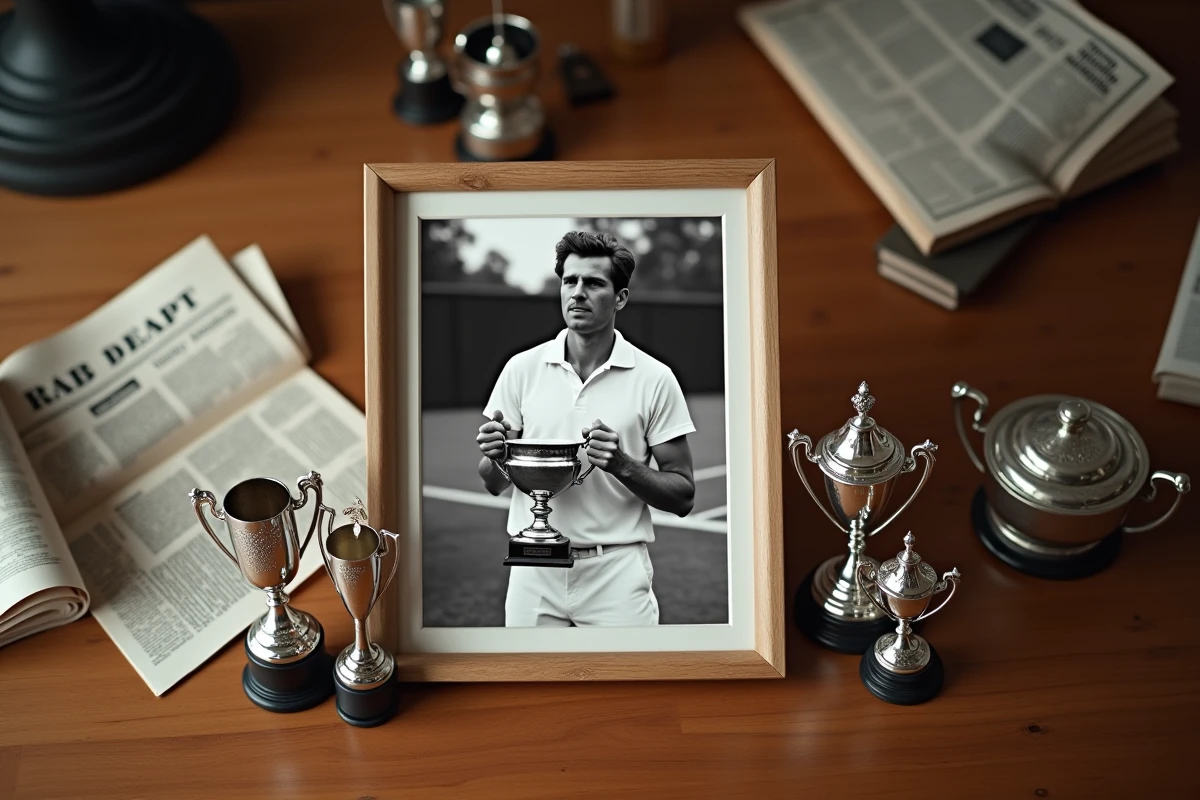
Rod Laver remains the name that comes up consistently when discussing the men’s calendar Grand Slam. The Australian achieved it twice: in 1962 and 1969. The second time is often considered the more remarkable, as it occurred in the Open era, against professionals who had previously been excluded from major tournaments.
Between 1963 and 1967, Laver could not participate in Grand Slam tournaments: he turned professional at a time when only amateurs had access. He thus lost five years of Grand Slam competition at the peak of his career. His 1969 victory takes on special significance when one considers this forced hiatus.
Before Laver: Don Budge in 1938
The first player to achieve the calendar Grand Slam was American Don Budge, in 1938. The context was different: professional tennis did not exist in its current form, and the four tournaments were mostly played on grass. Budge then left the amateur circuit to become professional, which took him away from the Majors.
Steffi Graf and the Golden Slam of 1988
In women’s tennis, Steffi Graf accomplished in 1988 what no female player had achieved before her (and none have achieved since): winning all four Majors and the Olympic gold medal in the same year. This is referred to as the Golden Slam, an even more demanding variant of the calendar Grand Slam.
The German dominated that season with a consistency that is hard to fathom. Her ability to adapt to both the grass of Wimbledon and the clay of Roland-Garros, then to the hard courts of the US Open and the Australian Open, perfectly illustrates why this feat has never been replicated in contemporary women’s tennis.
Maureen Connolly in 1953
Before Graf, Maureen Connolly achieved the calendar Grand Slam in 1953. The American player, nicknamed “Little Mo,” won all four Majors at just eighteen years old. Her career was abruptly interrupted by a horseback riding accident the following year, making her achievement all the more unique: she never had the chance to attempt it again.
Calendar Grand Slam, Career Grand Slam, or Non-Calendar Grand Slam: do not confuse
The media often mix up three distinct achievements. We can clearly differentiate them:
- Calendar Grand Slam: winning all four Majors in the same calendar year. This is the strictest and rarest version.
- Career Grand Slam: winning each Major at least once, without a calendar constraint. Several players have achieved this, including Rafael Nadal, Roger Federer, Novak Djokovic, Serena Williams, and Maria Sharapova.
- Non-Calendar Grand Slam: holding all four titles simultaneously, but spanning two seasons. Novak Djokovic achieved this between 2015 and 2016, winning Wimbledon, the US Open, the Australian Open, and then Roland-Garros.
The ITF, ATP, and WTA have gradually formalized these categories in their official communication, particularly after Djokovic’s performances and the reminder of Graf’s Golden Slam. This distinction is not just a matter of nomenclature: it reflects very different levels of difficulty.
Doubles and juniors: often overlooked calendar Grand Slams
The calendar Grand Slam is not limited to singles. In doubles, several players have achieved it, including Margaret Court (who also succeeded in singles in 1970, before the Open era in its current configuration) and Martina Navratilova. The ITF databases also list calendar Grand Slams in juniors.
French-speaking media tend to group all these categories under one label, while English sources and official statistics clearly separate them. A calendar Grand Slam in doubles and one in singles do not represent the same physical challenge or individual pressure, but both deserve to be documented.
In total, the list of players who have achieved the calendar Grand Slam in singles remains extremely short: Don Budge, Rod Laver (twice), Maureen Connolly, Margaret Court, and Steffi Graf. Since 1988, no one has joined this circle, despite Djokovic’s attempts in 2021 (losing in the US Open final) and the prolonged dominance of the Big Three on the men’s circuit. The current diversity of surfaces makes the feat perhaps more difficult than ever.