Traveling from Paris to Marseille with your own car without driving for hours on the A7 highway: this is the historic promise of the auto-train. This service, long offered by SNCF, allowed you to load your vehicle onto a wagon and find your car at your destination. However, the price of the Paris-Marseille auto-train and the access conditions have changed significantly in recent years, leading to confusion among travelers.
Why the SNCF auto-train Paris-Marseille no longer exists as it once did
SNCF gradually reduced and then eliminated its auto-train services on major French routes. The historic service, which allowed you to board your car on a night train between Paris and the southeast, has disappeared from the catalog.
This withdrawal is explained by a model that has become too costly to operate: aging specialized wagons, maintenance of loading stations, and declining ridership in the face of competition from TGV and carpooling. SNCF has chosen not to renew this equipment.
For those looking to understand the price of the auto train Paris-Marseille, the answer now lies in alternatives that operate differently from the old system.
Hiflow, the SNCF partner service for transporting your vehicle
Since 2023, SNCF Voyageurs has relied on Hiflow as its official partner for long-distance vehicle transport. The principle changes radically compared to the old auto-train.
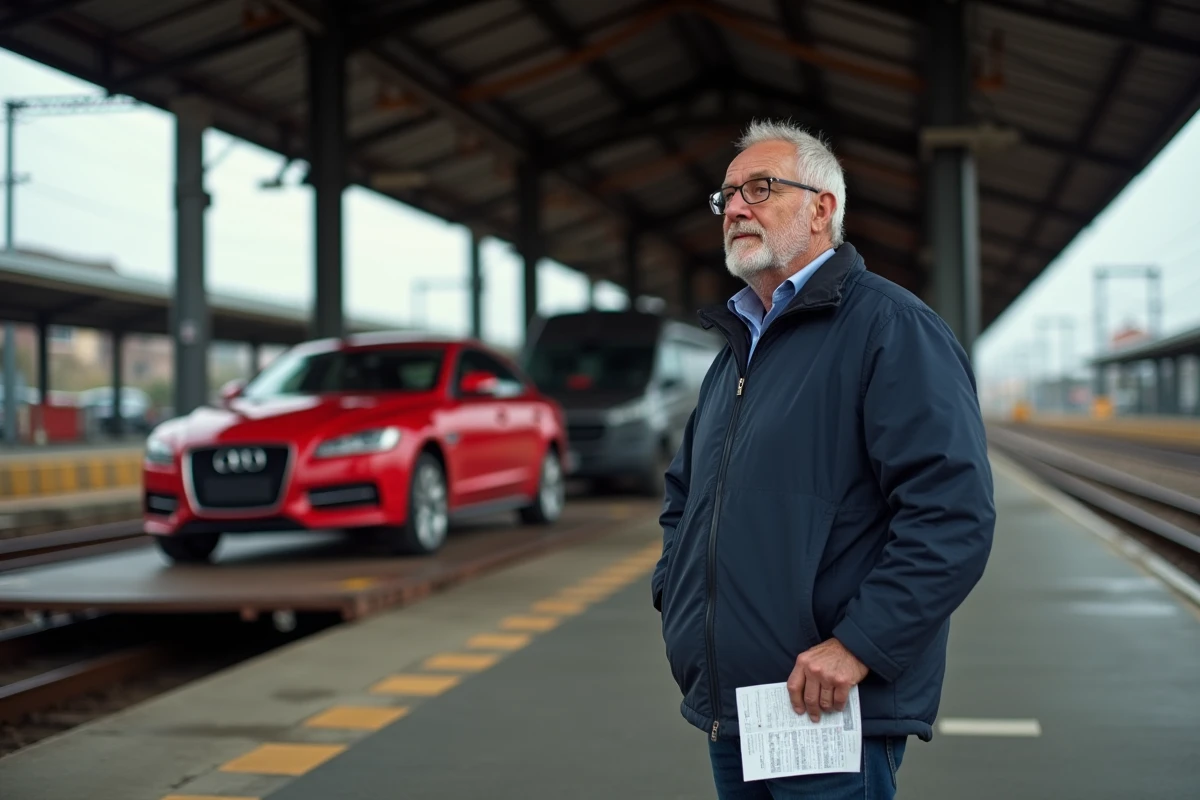
With Hiflow, your car is not loaded onto a wagon. A professional driver transports it by road to your destination while you travel separately, for example, by TGV. You drop off the vehicle at a meeting point and pick it up upon arrival.

What the Hiflow service covers
- Door-to-door or station-to-station transport of your vehicle, including routes like Paris to the southeast of France
- Specific insurance during transport, with an inventory check at departure and arrival
- The option to transport luggage in the trunk of the conveyed vehicle, which lightens your train journey
Have you noticed that this model resembles more of a car delivery service than a train? This is precisely the shift in philosophy. The vehicle travels, but you do not.
What changes in terms of pricing
The price of a Hiflow transport depends on the distance, the type of vehicle, and the desired timeframe. Unlike the old auto-train where the price was relatively standardized, the cost varies according to supply and demand. A transport on a highly demanded route during the summer will be more expensive than in the low season.
You must add to this price your personal train ticket (TGV, Ouigo, or other). The total of both can remain competitive compared to the overall cost of a highway trip if you factor in tolls, fuel, and the fatigue of a several-hour journey.
Auto-train in Europe: alternatives that still work
While the service has disappeared in France, auto-sleeper trains still operate in Europe. The Austrian ÖBB offers Nightjet connections that accept vehicles on certain routes, particularly between Germany and Austria or Italy.
For travelers crossing the Channel, Eurotunnel Le Shuttle remains a strict auto-train service: you drive your car onto the shuttle and retrieve it on the other side of the tunnel.
These examples show that the concept has not disappeared everywhere. In France, the question of reviving it is the subject of structured discussions.
Reviving the auto-train in France: where is the project now?
The FNAUT (National Federation of Transport User Associations) and the AUTAUT association advocate for the reopening of an auto-train service on major French routes, including Paris-Marseille. Their advocacy is based on a study published in December 2024 by The Shift Project.
This study concludes that the auto-train presents a significant climate benefit for journeys over 600 km. Paris-Marseille, with its approximately 775 km by road, fully falls into this category.

The analysis goes beyond a simple price comparison of the ticket. It incorporates the full cost to society: CO2 emissions, local pollution, road congestion. According to this report, the overall cost of an auto-train would be lower than that of individual car travel for most family configurations on a route like Paris-Marseille.
Why does this data matter? Because most online comparisons only consider the price paid by the traveler (ticket versus fuel and tolls). This approach ignores the costs borne by society, which ultimately weigh on public finances and thus on taxpayers.
Barriers to reopening
Reviving such a service requires heavy investments: acquiring new car-carrying wagons, adapting loading platforms at stations, and especially securing available rail paths on a network already saturated during peak hours.
No official timeline has been announced by SNCF or the Ministry of Transport. The project remains at the study and advocacy stage.
Comparing options for a Paris-Marseille trip with your car
While waiting for a possible revival, here are the available solutions for traveling with your vehicle between Paris and Marseille:
- Hiflow via SNCF Connect: vehicle transport by a driver, you take the train on your side. Booking on the SNCF Connect website
- Personal driving: A6 then A7 highway, with tolls and fuel. Expect several hours of driving depending on traffic
- Train only plus local rental: TGV Paris-Marseille in a few hours, then renting a vehicle upon arrival if necessary
The choice depends on the length of stay. For a week or more in the south, having your own car on-site justifies the extra cost of transport. For a long weekend, local rental will often be simpler and cheaper.
The auto-train service as it existed may not return in its historical form. The work of FNAUT and the Shift Project shows that the need remains real, but the response now involves hybrid formulas that combine rail transport and road conveyance.